Server-side GA4, Google Ads and Meta tracking for Shopify
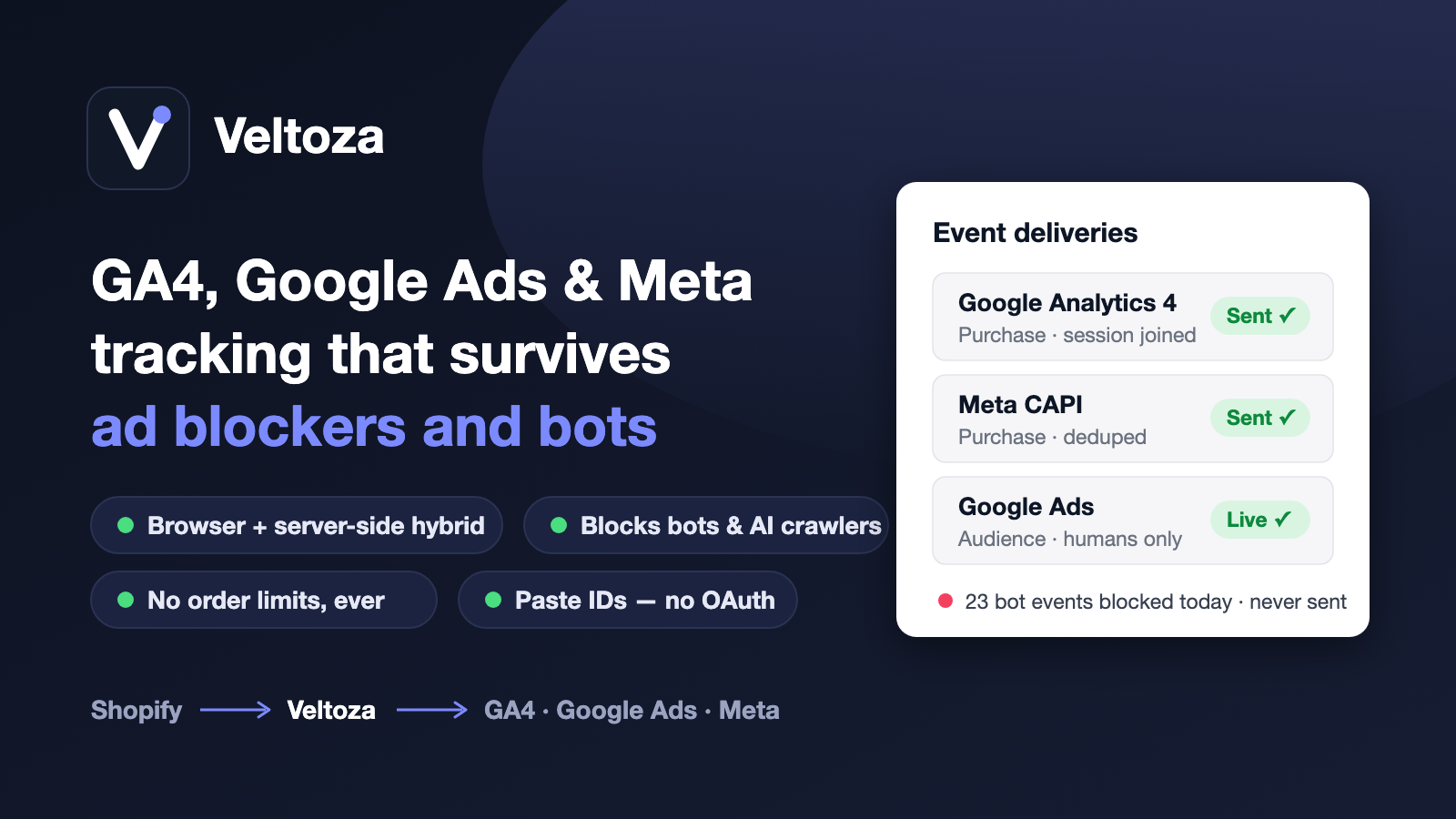
Your ad platforms only optimise on the conversions they can see. Ad blockers, Safari's tracking prevention and privacy extensions remove browser tags before they run, and bots inflate whatever survives. Veltoza sends every conversion from our servers as well as the browser, filters automated traffic before it is sent, and needs nothing from a developer.
Why browser-only tracking loses sales
A pixel is a script on your storefront, and anything on the shopper's device can remove it — ad blockers, tracking prevention, privacy extensions, a flaky mobile connection during checkout. When the tag never runs, the sale still happens but your ad platform never learns about it, so it bids as if that campaign did not work. Server-side delivery closes that gap: the event leaves our infrastructure, where nothing on the device can reach it.
Why the browser tag still has to load first
Server-only tracking has a failure of its own, and it is worse than it looks. Google Analytics 4 will not attribute a session that no browser tag created — every visit lands as "(not set)", and every report built on traffic source becomes useless. Veltoza loads the browser tags first so the session and its first-party cookies exist, then joins its server-side events to that same session with the same identifiers. Both copies of every event share one ID, so GA4 and Meta deduplicate them into one.
Bots and AI crawlers never reach your reports
This matters more for server-side events than most merchants realise: ad platforms filter bots by user agent, and a server-to-server event does not carry one. Whatever we send is trusted. So the filtering happens before anything is sent — known crawler signatures including GPTBot, ClaudeBot and PerplexityBot, the datacentre networks real shoppers never browse from, counterfeit device strings, and browser contradictions such as headless rendering scored on our side rather than in the page. Remarketing tags go one step further: they are never created until a real human interaction happens, so a crawler that loads a page and leaves can never join an audience. Purchases are deliberately exempt from the network check, so no real sale is ever lost to a shopper on a VPN.
Item IDs that match your product feed
Dynamic remarketing only works when the item IDs in your events match the IDs in your product feed. Shopify's Google channel writes them one way, the Meta catalog another, and a third-party feed app a third. Veltoza lets you pick the format per platform — Google channel, SKU, variant ID or product ID — so your dynamic ads show real products instead of nothing.
What you get
- Server-side conversion tracking that survives ad blockers
- Browser tags load first, so GA4 sessions and traffic sources stay accurate
- Bot and AI-crawler filtering before events reach your ad platforms
- One setup for GA4, Google Ads and Meta — no developer account needed
- Item IDs matched to your product feed so dynamic remarketing works
Set up in three steps
- Paste your IDs. GA4 Measurement ID and API secret, Google Ads conversion ID, Meta pixel ID and Conversions API token. Illustrated guides show exactly where each value lives. No OAuth, no developer account, no waiting for platform approval.
- Install the pixel. One click installs Shopify's official Web Pixel, which also covers checkout — where theme scripts cannot run.
- Enable the app embed. Switch it on in your theme editor and the browser tags go live. The app checks the theme itself and tells you honestly whether it is on.
Pricing
| Plan | Price | Platforms | Order limit |
|---|---|---|---|
| Solo | $19.99/mo | Any 1 platform | None |
| Duo | $34.99/mo | Any 2 platforms | None |
| Complete | $49.99/mo | GA4, Google Ads and Meta | None |
Server-side tracking is usually priced per order: competitors charge from $49 to $299 a month and then add a fee for every order beyond an included volume. Veltoza does not meter orders at any tier. A store doing ten sales a month and a store doing ten thousand pay the same price for the same plan.
Frequently asked
What exactly do I need to connect each platform?
Copy-and-paste values, no developer account and no API approval:
- Google Analytics 4 — Measurement ID and a Measurement Protocol API secret
- Google Ads — conversion ID, and the conversion label if you have one
- Meta — pixel ID and a Conversions API access token
Why is remarketing the one thing that cannot be server-side?
Audience membership requires Google's own tag to set a cookie in the visitor's real browser — there is no API that adds someone to a remarketing list from a server. So remarketing stays in the browser by necessity, while conversions go server-side for accuracy. Veltoza runs both and keeps them consistent, rather than pretending one approach covers everything.
Does this replace Google Analytics or Meta Ads?
No — it makes them accurate. Your reports stay in GA4, Google Ads and Meta. Veltoza makes sure the events those reports are built on actually arrive, and that bots are not among them.
Can I use it with only one platform?
Yes. The Solo plan covers any single platform, and you can switch plans in one click when you add another — Shopify prorates the difference.